Equine Reproduction
Stud Services
Here at Farr & Pursey Equine we offer a range of services to maximise your mare’s fertility, whether you choose to send her to stud for natural mating or opt for chilled semen artificial insemination (AI).
In order to maximise the chance of successfully producing a foal from your mare, we highly recommend that all mares undergo a pre-breeding examination in order to determine their suitability for breeding.
Equine Reproduction
Breeding from your mare
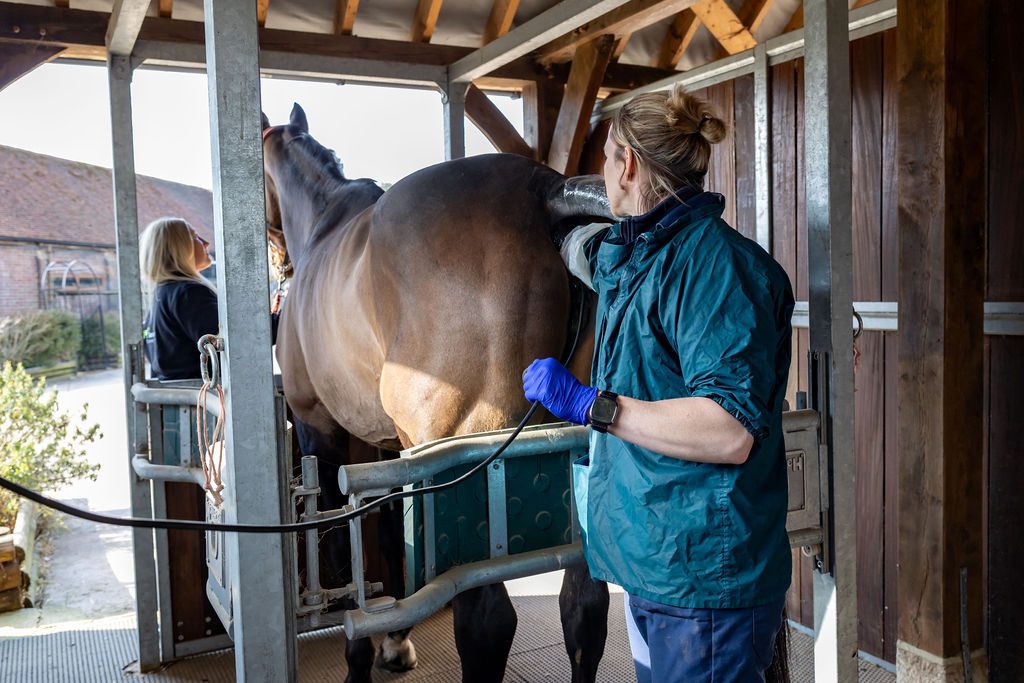
AI does, however, require greater veterinary input than natural service to ensure insemination occurs at the correct time in the mare’s reproductive cycle. This is achieved by sequential ultrasound examinations of the mare’s reproductive tract and the use of hormones to regulate the timing of ovulation.
Farr & Pursey Equine is experienced in the use of chilled semen AI and we have designed a competitively priced AI package to give your mare the best chance of getting in foal whilst allowing you to predict the cost per breeding cycle.
For further information or to discuss your mare’s specific requirements, please contact the practice or speak to Nikki Pursey MRCVS.
Equine Reproduction
Stages to consider when breeding
It is important to know if the mare has ever been bred from before and, if so, how successful the breeding attempts were and if there were any problems. Important information would include the number of foals the mare has already bred (and whether these were born alive or dead and if the foals suffered any problems early in life), details of the mare’s oestrous cycle (including length and duration of signs), previous breeding examinations and any investigations and/or treatment for subfertility.
It is important to consider the age of your mare; fertility declines when mares reach about 11 years old although, if a mare has foaled earlier in life, fertility is usually retained into the mid to late teens. Present use, body condition, previous/current health problems, injuries, vaccination history and whether the mare is currently receiving any medication are all important considerations too.
The mare should be checked to see how anatomically suitable she is for breeding. Any inherited traits, e.g. parrot mouth, should be carefully evaluated as foals bred from mares with these disorders may inherit the same problem. The mare’s external genitalia should be checked; older mares are susceptible to sinking of the anus which can compromise the anatomical barriers sealing the uterus, resulting in air and faeces being sucked into the vagina, reducing fertility. This type of conformation fault can, however, be corrected with a minor surgical procedure (a Caslick’s operation) performed under standing sedation and local anaesthesia.
In the UK, the most important diseases to screen for are the bacteria causing Contagious Equine Metritis (CEM), i.e. Taylorella equigenitalis, Klebsiella pneumoniae and Pseudomonas aeruginosa, and the virus causing Equine Viral Arteritis (EVA). CEM can be detected by a vet taking a clitoral swab at any stage of the mare’s cycle and sending the swab to an approved laboratory. If the results are negative then breeding can be allowed to proceed but if results are positive the mare must be treated, re-tested and declared free from infection before breeding can occur. EVA can be detected by taking a blood sample and sending it to an approved laboratory. CEM and EVA can have devastating consequences, including abortion, disruption of breeding and financial loss; for these reasons, these diseases are notifiable by law.
Some studs may require additional tests, e.g. screening for Strangles, before mares are allowed to go to stud. It is important that you check with the stud regarding their specific requirements and allow plenty of time for the tests to be performed before the mare is due to go to stud.
The Horserace Betting Levy Board produces annual “Codes of “Practice” with regard to recommendations for prevention and control of these diseases; a copy of this is available online at www.hblb.org.uk.
A vaginal examination allows the vet to examine the cervix to make sure it is functioning correctly. The cervix acts as the final physical barrier between the uterus and the external environment; any damage to the cervix can result in the formation of scar tissue which can prevent the cervix from functioning properly, resulting in fluid accumulation in the uterus, thus reducing fertility.
Done on your yard during the reproductive consult
Done on your yard during the reproductive consult
This allows the vet to assess whether the ovaries are cycling properly and also allows evaluation of the uterus for the presence of cysts and/or fluid accumulation, both of which can negatively affect fertility.
Other examinations, e.g. endometrial swabs, may also be performed at the vet’s discretion depending on the mare’s health and reproductive history.
For further information or to discuss your mare’s specific requirements, please contact the practice or speak to Nikki Pursey MRCVS.
with Chilled Semen
Artificial Insemination (AI)
Advantages of using AI with chilled semen:
Increased choice of stallions, including those in mainland Europe
Reduced risk of injury to mares, stallions and handlers
Reduced risk of transmission of venereal diseases, e.g. CEM and EVA
Older mares who may be more susceptible to uterine fluid retention/infections after mating have a better chance of conceiving with AI
Once you have selected a stallion for your mare and she has undergone a successful pre-breeding examination, the process of AI can begin. It is advisable for the first ultrasound scan of her ovaries and uterus to be performed as soon as the mare shows signs of being in season. Some mares do not obviously show when they are in season but an ultrasound examination of her ovaries and uterus should help the vet to determine which stage of the cycle she is in. If necessary, the mare can be given an injection of prostaglandin to bring her in to season.
Regular ultrasound examinations are then performed to monitor the ovaries and the development of follicles, allowing us to more accurately predict the timing of ovulation. Once the developing follicle reaches a specific size, the mare can be given hormones to help regulate the timing of ovulation.
At this point the semen is usually ordered for insemination the following day. All semen should be accompanied by the relevant paperwork and, if coming from abroad, the appropriate export health certificate. If the semen does not arrive with the correct paperwork, the vet will not be able to use the semen for insemination. It is important to check with the stallion manager if there are any limitations on semen availability; some studs do not collect semen at the weekend and some stallions may be away competing at certain times of the year.
Upon delivery of the semen, the vet will check the paperwork and assess the fertility of the semen. Then, if all is well, it will be inseminated into the mare. Chilled semen is ideally inseminated 12 to 18 hours prior to ovulation.
The mare should undergo a further ultrasound examination after insemination to check for ovulation and for any fluid accumulation in the uterus. If necessary, the uterus can be lavaged and/or antibiotics instilled into the uterus to prevent any uterine infection.

Includes:
Visit fee
Basic clinical examination
Speculum examination of vagina and cervix
Rectal examination of reproductive tract
Clitoral swab for Contagious Equine Metritis (CEM) + laboratory fees
Blood sample for Equine Viral Arteritis (EVA) + laboratory fees
Ultrasound examination of uterus and ovaries
This package price does not include:
Sedation (if required)
Taking samples for other infectious diseases (e.g. EIA, Strangles etc.)
Laboratory fees for tests for other infectious diseases
All fees include VAT.
For bookings, further information or to discuss your mare’s specific requirements, please contact the practice or speak to Nikki Pursey MRCVS.
Includes:
Reproductive ultrasound examinations to monitor ovaries
Ovulation induction agent
Insemination of mare and assessment of semen
Post-ovulation ultrasound examination
One post-insemination treatment as required (including oxytocin, saline lavage and intrauterine antibiotics)
Two pregnancy scans (at approximately 15 and 30 days)
This package price does not include:
Visit fees
Sedation (if required)
Pre-breeding swabs or blood tests
Treatment to bring the mare into season
Manual reduction of twins
Treatment of any disease/illness not associated with breeding
Subsequent post-insemination treatments if required
This package is not a guarantee of success but offers the best chance of your mare being in foal per cycle. If your mare does not conceive following the first insemination, further inseminations can be performed (at an additional cost).
All fees include VAT.
The full package price must be paid before treatment commences. The 5% prompt payment discount does not apply to the package fee but will be applied to all non-inclusive fees (e.g. visit fees, sedation etc.) if paid at the time or within 24 hours of the visit.
Subsequent cycle package costs are £408.84 (incl VAT) per cycle.
For bookings, further information or to discuss your mare’s specific requirements, please contact the practice or speak to Nikki Pursey MRCVS.